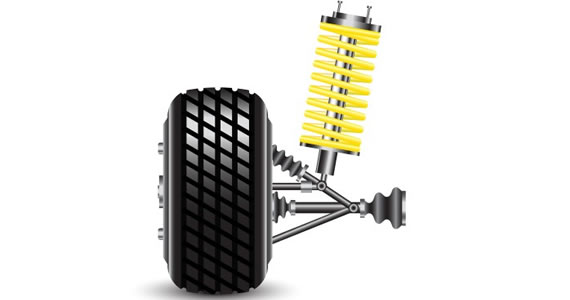
Your vehicle’s suspension is a vital system – it ensures that you have a comfortable ride on virtually any driving surface, but it also helps provide better handling and even ensures longevity for your vehicle by eliminating jarring bumps and vibrations that would otherwise compromise its integrity. Your suspension system is actually built from a variety of different components, and understanding what these are and how they work is important, whether you’re repairing a blown shock or lowering your ride. The three most important components to know are your shocks, struts and springs.
Shocks and Struts
Shocks and struts are very similar to each other, and it can be tempting to think that they’re the same. They do the same job – a hydraulic piston is mounted within a framework that’s bolted to the vehicle above one of the four wheels. When your vehicle encounters a bump or dip, the piston extends or retracts in order to keep the vehicle level and reduce jarring/bouncing. However, while they do a similar job, they’re different components.
The main difference between the two is in the design of the component. Both shocks and struts can be found on the front or rear of the vehicle. Of the two, struts are more versatile, as they are actually structural components of the suspension system. Shocks, on the other hand, are more of a “bolt-on” solution for bounce control. As such, struts are generally more expensive than shocks and they can be used for more than just controlling spring motion – they can also be used as pivot points in the suspension and can take the place of other suspension components.
Springs
Springs are important components and work with both shocks and struts to control spring motion. You’ll find that buying a set of aftermarket springs gives you a set of four – two shorter springs for the rear and two longer ones for the front. There’s a very good reason for this. The front of the vehicle requires considerably stronger support and bounce control due to the weight of the engine and the effect of spring motion on steering. The rear of the vehicle, on the other hand, is very light (in comparison, of course), and does not require as much control or the same level of stability.
You’ll also find aftermarket coil over springs. These differ from OEM replacement springs in that they are designed to work in tandem with aftermarket shocks and struts to lower your vehicle. Coil over springs can provide substantial control, but you’ll sacrifice comfort when lowering your vehicle. Essentially, it reduces not only the height of the vehicle to the road, but the amount of travel in the strut/shock assemblies. The result is a “hard” suspension.
Considerations When Replacing Shocks, Struts and Springs
There will come a time when you need to replace your suspension components. Shocks and struts are both prone to wear damage. Eventually, the fluid seals that keep the hydraulic fluid within the chamber will wear out. This can lead to either a slow leak or immediate failure. Strut/shock failure should be immediately noticeable and usually presents as a “knocking” sound/feel when traveling over bumps and rough road surfaces.
When replacing your suspension components, it’s important to purchase items that are made for your specific vehicle. You’ll find a range of “universal” fit components out there, but these are really subpar solutions to your needs. Vehicle-specific components are designed with your vehicle in mind, which means they’re engineered to provide the best performance possible, while supporting your vehicle’s weight, providing steering control and offering a more comfortable ride.
Don Elfrink is the Owner and Operator of AutoMatStore.com where he specializes in selling custom floor mats. Prior to owning AutoMatStore, Elfrink worked in the automotive industry for over 30 years.


 Gracie Hayden: Exactly, If we maintained our vehicle regularly, It will work properly...
 nathaliebieleu: This is one to get roadworthy and just drive and enjoy...
 James King: What if someone suffer from bad credit history?...
 Dorothy Catlett: I think, Parents should teach their kids by purchase a car with LOAN t...


